SMB teams
Product studio from The Lodestone Group
Salesforce-ready apps for the work your team keeps handling manually.
TLG Labs turns recurring CRM, error recovery, communications, document collaboration, reporting, and handoff work into focused products with clear implementation paths and real utility for Salesforce teams.
08
products
06
available
01
flagship
product surface / catalog
SMB-friendly, enterprise-ready apps
Salesforce-ready

LookingGlass
Aegis Flow
InventoryMagic
MemberTitan
Quillio
QuickBridge
CanaryAI
SwiftSign
product demos
pilot paths
app builds
Flagship Product / available for private demo
LookingGlass gives Salesforce revenue teams a cleaner view of demand.
The first TLG Labs product is built around a practical revenue problem: anonymous traffic hides useful buying signals. LookingGlass enriches visitor IPs, caches known matches, and gives teams a cleaner path from website activity to account follow-up.
Website pixel
Enrichment cache
CRM handoff
01
Identify account
02
Enrich context
03
Route next action
 Live product surface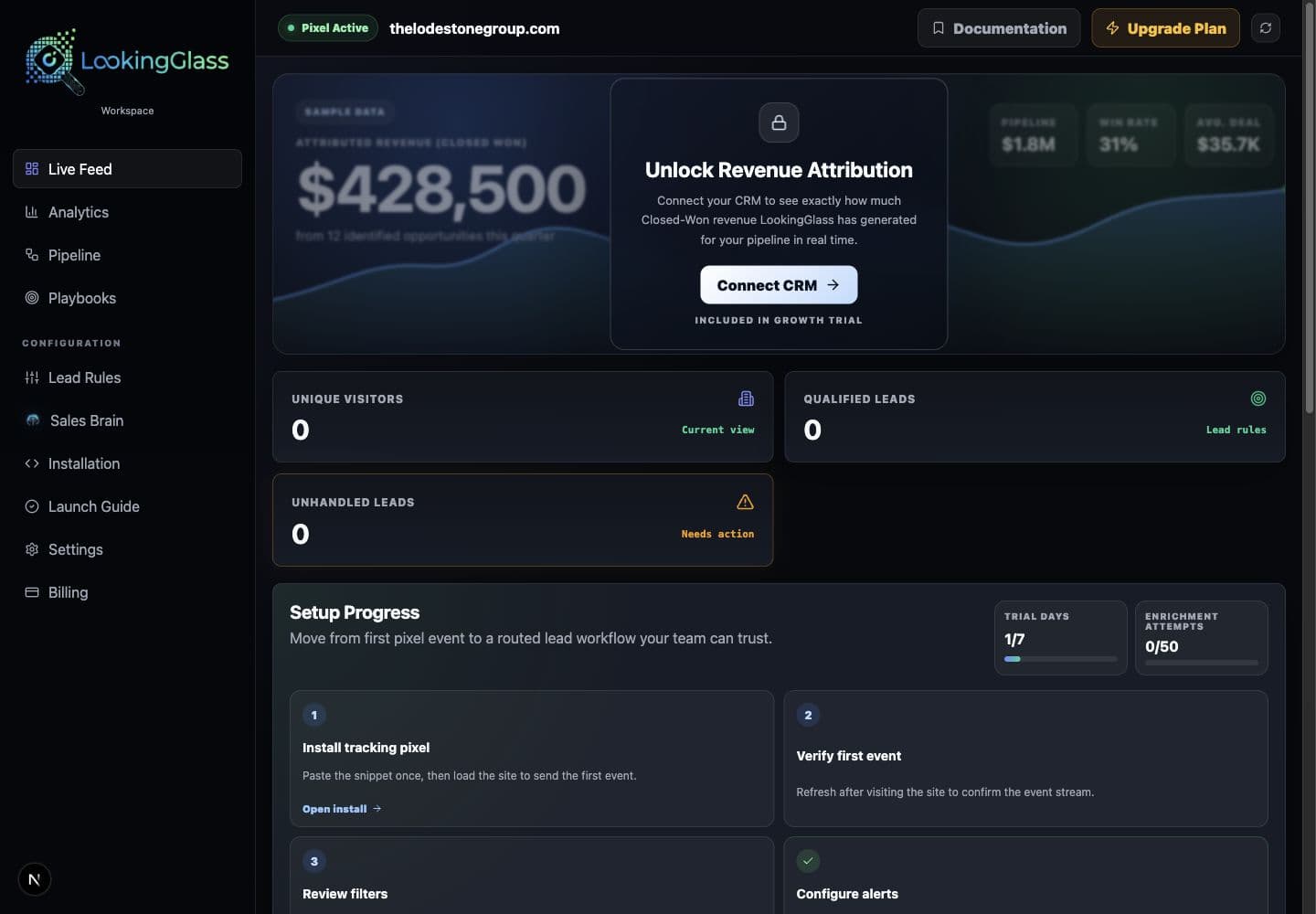
New Product / Available for private demo
Smart Diagnostics. Bounded AI. Absolute Governance.
When Salesforce breaks, turn the error into a safe next step.
Aegis Flow captures what failed, where it happened, and what the user was trying to do. It explains likely cause, guides approved recovery when available, and sends unresolved issues forward with the context admins and developers need.
Evidence capturePlain-language diagnosisGoverned recoveryComplete escalation
Aegis FlowRecovery session
Recovery path
Demo scenario / Order tax calculation
Missing Account tax code
Known rule matched01
CaptureUser, record, source process, original error, and correlation ID
02
DiagnoseKnown rules first, then Agentforce guidance with confidence
03
RecoverApproved Apex or Flow action after confirmation and security checks
04
EscalateDeveloper-ready evidence when the issue needs human review
Approved actions only. Salesforce security, explicit confirmation, sensitive-data controls, and an audit trail remain in the path.
Buyer Paths
Choose the path that matches the pressure you already see.
The same catalog can support different paths: a quick app conversation, a growth-stage systems gap, an enterprise pilot, or a Salesforce account conversation that needs a credible next step.
Growth teams
Connect the work between systems.
Turn spreadsheets, CRM updates, calls, documents, and follow-up steps into cleaner paths your team can repeat.Enterprise teams
Pilot with implementation clarity.
Evaluate a product with a clear scope, data path, launch plan, and human review points before it reaches procurement.Salesforce AEs
Extend Salesforce conversations.
Point customers toward Salesforce-ready apps that solve related work without positioning a replacement platform.Product Catalog / available paths
Focused products for the work teams keep repeating.
The catalog is intentionally narrow: tools for visitor traffic, Salesforce error recovery, inventory pressure, member operations, integrations, agreements, documents, and multichannel communications. Each product has a specific use case, connection model, and evaluation path.
06 available02 in lab01 custom app path
Evaluation fit
Start with the business problem, then pick the product path.
Salesforce-ready work that needs a better product surface
Clear owner, painful manual step, and measurable outcome
Narrow enough to demo, pilot, or build without a platform rewrite
App catalog
Find the product path that matches the problem.
Showing 1 of 8
Private demo
LookingGlass
Visitor and account intelligence
Identify the companies visiting your site, separate real buying interest from noise, and route account context into Salesforce.
Built for
Revenue teams with high-consideration web traffic
Connects to
Web pixel / Salesforce / Sheets
Focus
Visitor intent, account fit, Salesforce routing
Built from Lodestone's own account identification process.



Public Evidence / delivery record
New products. A delivery record buyers can inspect.
TLG Labs does not use anonymous ROI claims to make early products look mature. Start with the working product surfaces and scoped pilot measures, then verify the team behind them through Salesforce and named Lodestone delivery stories.
Independent signal
The Lodestone Group on AppExchange
5-starAppExchange ratingVerified Salesforce reviews
12Verified projectsReported by Salesforce
10Certified expertsQualifying Salesforce credentials
Named delivery stories
Public work behind the product studio
Sales Cloud + ERP readiness
CASP Aerospace
Experience Cloud + commerce operations
Madison Avenue Couture
Enterprise Fit / evaluation-ready
Built for teams that need software to survive real operations.
TLG Labs products are designed for buyers who care about adoption, implementation, data quality, and responsible automation as much as the interface. The work is narrow by design, but the operating standards are serious.
Salesforce-ready by default
Products are shaped around CRM teams, Salesforce data, service handoffs, and revenue workflows.
Clear implementation path
Discovery, pilot scope, launch support, and production hardening are treated as part of the product experience.
Data movement people can audit
Events, conversations, documents, and records are logged in ways teams can search, audit, summarize, and act on.
Automation where it helps
Summaries and recommendations stay tied to records, conversations, documents, and human review.
Build With TLG Labs / custom apps
When the right product does not exist yet, build the narrow one first.
The lab is also a custom app path for qualified client problems. We help shape focused Salesforce-ready apps, reporting tools, document systems, communications layers, and approved automations around work your team already feels every week.
Discuss a Salesforce App Buildbuild layer 01
Product qualification
Define the owner, painful manual step, and measurable reason to build.
build layer 02
Prototype to pilot
Get a working app in front of operators before the idea turns into a platform.
build layer 03
Salesforce integration
Build around CRM data, documents, communications, reporting, and approved next steps.
Product fit / build / enterprise
Tell us what your Salesforce team is trying to improve.
We'll review the operating problem, prepare before we respond, and point you toward the most practical next step.
A product recommendation when an existing app fits
A focused build path when the right app does not exist
An enterprise evaluation path for security and implementation teams