Capture the right evidence
Preserve the user, record, source process, original error, available logs, and correlation ID before context disappears.
The Salesforce error intelligence platform
Aegis Flow captures the right evidence, diagnoses the root cause, and guides your team toward a faster, safer path to resolution.
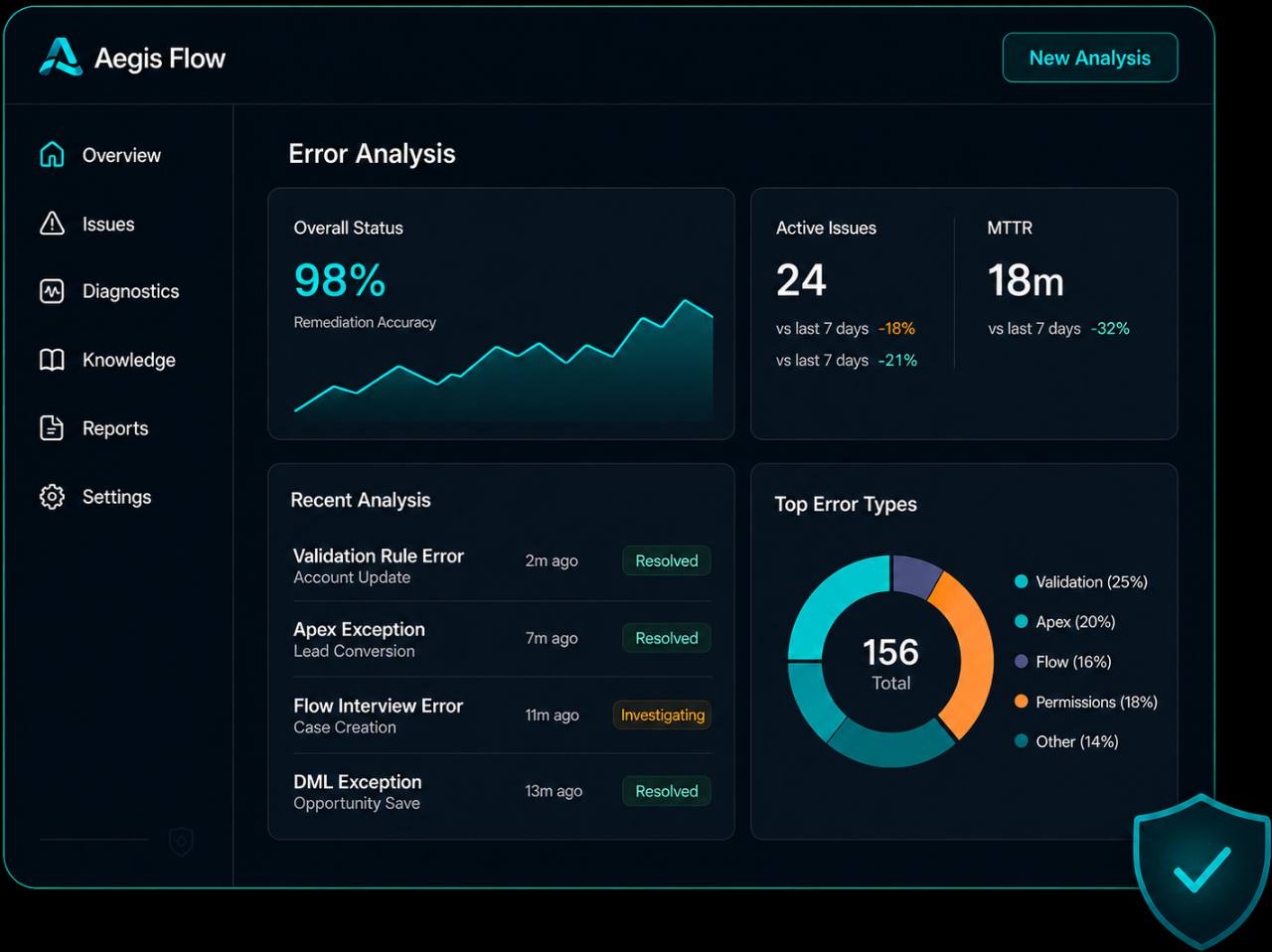
Built for Salesforce teams
When errors happen, the costly part is often reconstructing what happened. Aegis Flow turns a vague failure into a governed path for diagnosis, recovery, or escalation.
Preserve the user, record, source process, original error, available logs, and correlation ID before context disappears.
Apply known rules first, then explain likely root cause in language that works for users and technical teams.
Guide only approved recovery actions—or send a complete diagnostic package to the right technical owner.
Why Aegis Flow
Give the next owner the context they usually have to chase down.
Use known-error rules before broader AI-assisted diagnosis.
Give users, admins, developers, and partners context they can act on.
Require approved actions, security checks, and confirmation for writes.
Built for everyday challenges
Start with the error paths that create the most support pressure, then add governed recovery where the team is ready for it.
Preserve exception context and route developer-only failures with useful evidence.
Identify the source automation, attempted action, and failed path.
Separate access issues from process failures before anyone changes the system.
Explain missing values, validation conflicts, and record-level blockers.
Carry source, timing, and correlation context into API and middleware review.
One end-to-end demo path
The private demo uses a concrete Salesforce failure to show both outcomes: approved recovery when the issue is eligible, and a developer-ready escalation when it is not.
The process fails because the related Account is missing its tax code.
Aegis Flow captures the Order, user, process, original error, and correlation ID, then identifies the missing Account value.
The user is asked for the missing value and sees the exact approved update before confirming it.
If recovery is not eligible or does not succeed, the issue moves to a developer with the complete diagnostic package.
The Aegis trust model
Aegis Flow is designed to help teams move with more confidence without hiding consequential changes behind an AI response.
A practical pilot
Best for Salesforce teams with meaningful automation, recurring support pressure, or complex handoffs between users, admins, developers, and outside partners.
Connect the highest-value error paths across Flow, Apex, LWC, async jobs, or integrations.
Configure known-error rules, sensitive-data masking, severity, and approved remediation actions.
Add the Help Me utility and route unresolved issues to the right admin, developer, or support owner.
Validate diagnosis, confirmation, audit, retry, and escalation behavior against real sandbox scenarios.
Pilot scorecard
Confirm the first escalation contains the record, source, action, error, logs, and correlation context the next owner needs.
Review whether known rules and confidence-bearing explanations help users and technical owners choose the right next step.
Validate eligibility, Salesforce security, explicit confirmation, audit history, retry behavior, and safe fallback.
Frequently asked questions
The product is designed to make evidence, confidence, recovery eligibility, and escalation behavior reviewable from the start.
No. Aegis Flow is designed around configured recovery actions, Salesforce security, explicit confirmation for writes, and escalation when an issue is not eligible.
The pilot starts with selected high-value paths across Flow, Apex, LWC, async jobs, or integrations where the team can capture useful context and define ownership.
Low-confidence and developer-only issues are escalated with the original evidence, diagnosis context, logs, and recommended review points intact.
Use real sandbox scenarios to validate evidence capture, rules, masking, confirmation, audit, retry, and escalation behavior before approving any production recovery path.
See Aegis Flow in action
Turn a recurring failure into a concrete conversation about evidence, diagnosis, safe recovery, and escalation.